

Europe is facing a decisive stage marked by the energy transition, reindustrialization, strategic autonomy, and the need to ensure secure and sustainable supply chains. In this context, mining and mineral raw materials are emerging as an essential strategic pillar, not only to sustain industrial and technological development, but also to meet the European Union’s climate, social, and economic objectives.
Under the motto “Mining: A Strategic Pillar for Europe’s Future,” MMH proposes a comprehensive vision of the mining sector that covers the entire project life cycle, from exploration and the development of new deposits to processing, restoration, closure, and reinvestment, integrating technical, regulatory, financial, social, and environmental aspects. Presentations must fit within this common framework, understanding mining as a complex and interconnected system in which every technical, regulatory, or economic decision has a direct impact on the sector’s competitiveness, sustainability, and social acceptance.
The event invites the submission of real cases and new projects, both national and international, enabling the extraction of practical lessons regarding the success factors and obstacles that shape the development of strategic mining initiatives in Europe. Special attention will be given to projects aligned with European raw materials policies, funding programs, and current and future strategic frameworks.
MMH also promotes a rigorous analysis of the regulatory framework, understanding regulation as a key element to ensure legal certainty, environmental protection, technological innovation, and operational efficiency. Contributions should reflect on how to move toward evidence-based regulations that are consistent with technological progress and capable of balancing competitiveness, sustainability, and the protection of the public interest.
The event’s cross-cutting approach also incorporates project financing and promotion, talent and human resource development, modernization and optimization of operations, integration of R&D&I and digitalization, and the sector’s energy transformation as fundamental levers for a more efficient, decarbonized, and resilient mining industry.
Additionally, topics addressing current challenges for the sector will be discussed, including issues of concern to leading mining industry companies at national and regional levels, while also analyzing the international context in search of practical and actionable solutions.
Finally, all presentations must consider sustainability in its broadest sense, integrating ESG criteria, governance, social license to operate, and shared value creation. MMH aims to consolidate a common narrative in which mining actively contributes to rural development, quality employment, and territorial cohesion, reinforcing its role as a driver of economic, social, and environmental progress for Europe.
This guiding thread seeks to align technical and scientific contributions toward a shared vision: a modern, responsible, knowledge-based European mining industry capable of responding to present challenges and sustaining Europe’s strategic future.
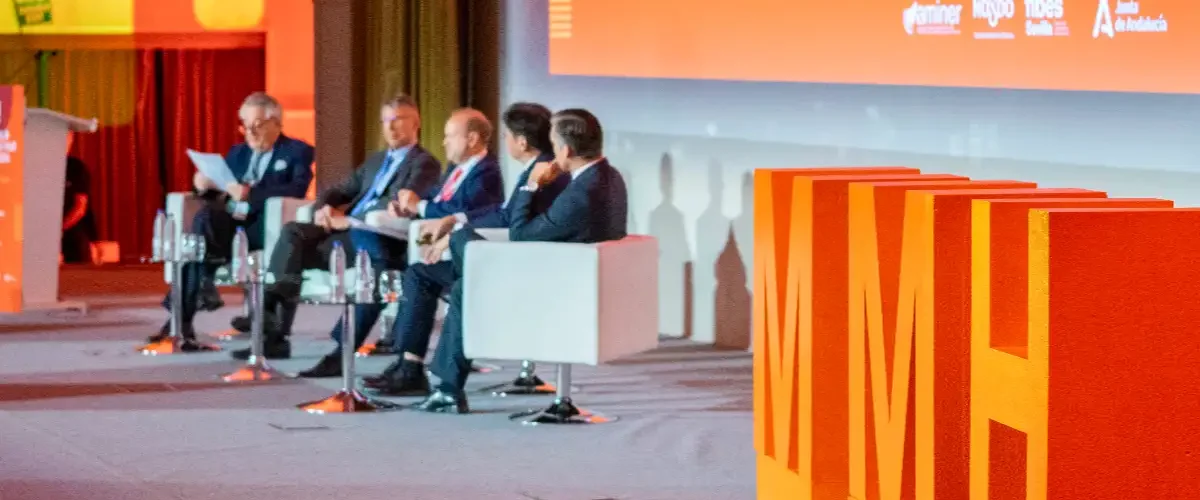
In a European context marked by energy transition, reindustrialization, and the need to ensure secure access to strategic raw materials, mining is positioned as an essential pillar for the future of Europe. Its role is key to sustaining industrial competitiveness, advancing climate goals, and strengthening the strategic autonomy of the European Union.
Under the slogan “Mining: a strategic pillar for the future of Europe,” the MMH proposes a comprehensive approach that covers the entire life cycle of mining activity, integrating real cases, new projects, regulatory framework, financing, sustainability, industrial transformation, innovation, digitization, and energy transition. Presentations should align with this cross-cutting vision, providing technical and scientific analysis and practical experiences that contribute to modern, responsible, competitive, and socially accepted mining, capable of generating long-term economic, social, and environmental value.
International and national cases of new mining deposit development will be valued.
The V edition of MMH2024 closed with a list of new projects that had been authorized and were in the process of being implemented in the years leading up to 2024. The current edition will address new cases or cases that have not proliferated and have not been carried out despite good forecasts (“lessons learned”).
Strategic projects PNEM 2026–2030.
Compliance with current regulations (national, regional, or international).
The harmonization of regulations with scientific and technological advances.
The impact of regulation on innovation, safety, sustainability, quality, or efficiency of the systems studied.
The development, updating, or improvement of technical and regulatory standards based on scientific evidence.
Papers may address critical analyses of the current regulatory framework, proposals for improvement, regulatory models, comparative studies, case studies, or practical experiences, always supported by technical and scientific evidence.
Material and human resource needs, training, talent, etc., across all phases of the mining life cycle and value chain. Example:
Life cycle:
This thematic area will address the governance of mineral raw materials from a comprehensive perspective that integrates ESG criteria, social acceptance, and shared value creation, placing sustainability in its broadest sense at the core. It will examine transparent and participatory governance models, the social license to operate, responsible land management, and the sector’s contribution to rural development, quality employment, and territorial cohesion. The block will provide a space to discuss how to align extractive and processing activities with social and environmental expectations, embed best practices across the entire value chain, and strengthen the role of mineral raw materials as a driver of long-term economic, social, and environmental sustainability.
Topics related to final transformation processes for obtaining pure metals — a key block for European self-sufficiency in critical raw materials and reducing dependence on countries such as China, which leads global refined copper production.
This section on R&D&I and digitalization brings together innovative initiatives applied to mineral raw materials, positioning them as a strategic driver for advancing a more efficient, sustainable, and competitive industry capable of addressing the challenges of the ecological transition and strategic autonomy. Technologies applied to mineral exploration, along with advanced sensors, process automation and robotization, data analytics, artificial intelligence, digital twins, and digital traceability, are transforming every stage of the value chain—from exploration and extraction to processing, restoration, and recycling—enhancing productivity, reducing environmental impacts, and strengthening safety and social acceptance. This thematic area explores how technological innovation and digitalization act as key enablers for optimizing resource use, fostering the circular economy, attracting talent, and positioning the mineral raw materials sector as a central pillar of a modern, resilient industry aligned with climate and sustainability objectives.
Use of renewable energy, decarbonization, emissions taxation.
The energy transition of the mineral raw materials sector requires accelerating the deployment of renewable energy, electrifying processes, and improving efficiency to advance decarbonization without compromising competitiveness or security of supply. This thematic area will examine how to integrate solutions such as on-site self-consumption and power purchase agreements (PPAs), industrial heat electrification, alternative fuels, and digitalization to reduce energy intensity and carbon footprint across extraction, processing, and logistics. It will also assess the role of carbon pricing instruments—such as the EU Emissions Trading System (ETS), compensation for indirect costs, the Carbon Border Adjustment Mechanism (CBAM), and national emissions taxes—in shaping investment decisions, addressing the risk of carbon leakage, and ensuring regulatory frameworks and support measures that enable a realistic and measurable transition aligned with climate objectives.
Crucial aspects of the infrastructure required to carry out a mining project in the area where mineral resources are located and intended to be processed, such as power grids, water supply, civil works, and protected areas.
Both technical and commercial presentations will last 30 minutes and will take place in the presentation rooms designated by the organisers.
Short talks will be organised in an exhibition area, outside the lecture halls, so that they can be easily heard and participants can interact with the speaker. Listening and questioning facilities will be provided (mobile app and microphones).
At least one of the authors must be present during the time reserved for the poster defence in case their intervention is necessary.
The defence will be reserved through the app in the ‘Innovation Hub’ section.
Proposals must be submitted exclusively via the attached online form, and the deadline for receipt is Wednesday, 30 April 2026.
Once the deadline has passed, the Scientific Committee will assess the suitability of the applications, accepting those it considers appropriate based on their subject matter, the quality of the proposal and the merits of the speaker.
The absence of any information may be grounds for rejection by the Scientific Committee.
The dimensions and characteristics of the poster will be confirmed in advance so that it can be designed and sent to the organisers for display.
Submit your proposal for a presentation aligned with the thematic areas of MMH 2026.



























info@mmhevent.com
luisfueyo@mmhevent.com
communication@mmhevent.com
© Copyright 2026 - MMH Mining and Minerals Hall | Diseñado por 🦆 Agencia Mamá Pato

Complete el siguiente formulario para poder ofrecerle toda la información del evento.